You Won’t Believe What I Found at Uluru—Hidden Spots That Changed My Trip
Uluru isn’t just a rock—it’s a living landscape that pulses with culture and quiet magic. I went expecting stunning sunsets, but left with something deeper: unexpected leisure spots where time slows and beauty sinks in. From secluded viewing corners to cultural spaces that few tourists see, my discovery journey revealed how to truly connect with this sacred place. This is not just sightseeing—it’s soul-stirring travel done right.
First Impressions: Beyond the Postcard View
Arriving at Uluru for the first time, one cannot help but feel a sense of awe as the massive sandstone monolith rises abruptly from the flat, rust-colored desert floor. The sheer scale of it—348 meters high and stretching over 9.4 kilometers around the base—defies expectation. Most visitors arrive with cameras ready, drawn by the iconic images of golden light at dawn or the fiery red glow at sunset. These moments are undeniably powerful, yet they represent only a fraction of what Uluru offers. The commercialized viewing areas near the main car park are well-maintained and accessible, offering clear sightlines and information boards. However, the crowds that gather there often leave little room for quiet reflection. This contrast—between the spectacle and the stillness—sparked a personal quest to explore beyond the postcard-perfect scenes.
What many first-time travelers don’t fully grasp is that Uluru is not merely a geological wonder; it is a living cultural landscape for the Anangu, the Traditional Owners of this land. For tens of thousands of years, this place has been central to spiritual beliefs, law, and daily life. Every crack, cave, and contour holds stories from the Tjukurpa—the Dreamtime—where ancestral beings shaped the world. Approaching Uluru with reverence means recognizing that it is not a backdrop for selfies, but a heartland of living heritage. This understanding transforms the visitor experience from passive observation to active respect. When travelers take time to learn about Anangu culture before stepping onto the land, their journey becomes more meaningful and grounded in authenticity.
The initial excitement of seeing Uluru up close often gives way to a deeper curiosity. Why are certain areas roped off? What lies beyond the main walking trails? Who are the people whose voices echo through these stories? These questions, when asked with sincerity, open the door to more thoughtful exploration. The commercial zones serve an important purpose in managing tourism, but they also act as gateways to quieter, more intimate experiences just a short walk away. The key is knowing where to look—and how to look—with patience and humility.
The Magic of Sunrise (and Why You Shouldn’t Stop There)
No visit to Uluru feels complete without witnessing sunrise at Talinguru Nyakunytjaku, the designated viewing area located east of the rock. As the first light touches the horizon, the sky shifts through soft pinks and oranges before the sun’s rays ignite Uluru’s surface in a deep, radiant red. The transformation is almost theatrical, drawing gasps from onlookers and a spontaneous hush over the crowd. Tripods line the viewing platform, and tour buses arrive well before dawn, all in pursuit of this fleeting moment. While the experience is breathtaking, it is also highly structured—timed, guided, and shared with dozens, sometimes hundreds, of others.
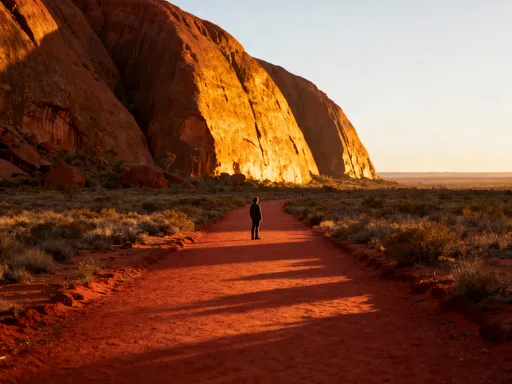
There is undeniable value in this ritual. The sunrise at Uluru is a universal symbol of renewal and connection, a shared human moment that transcends language and culture. However, limiting one’s visit to this single event risks reducing the entire site to a performance rather than a place of presence. The true magic of Uluru unfolds not in minutes, but in hours—in the slow unfolding of light, sound, and silence throughout the day. After the morning crowd disperses, a different kind of stillness settles over the land. The heat of midday brings shimmering waves above the desert floor, and the rock’s color softens into a warm ochre. By late afternoon, shadows stretch long across the sand, and the air cools gently.
These quieter moments offer rare opportunities for contemplation. A bench tucked behind a low ridge, a shaded overhang along the base walk, or a quiet corner of the cultural center can become personal sanctuaries. Travelers who linger past sunrise often discover that Uluru reveals itself differently when not framed by expectation. The absence of crowds allows for deeper listening—not just to the wind or distant bird calls, but to the subtle rhythms of the land itself. To truly engage with Uluru is to move beyond the checklist of must-see moments and embrace the leisure of being present, wherever you are and whenever you choose to pause.
Secret Viewing Spots: Where the Crowd Fades and the Spirit Rises
While the main viewing areas draw the majority of visitors, several lesser-known vantage points around Uluru offer solitude and intimacy. These hidden spots are not secret in the sense of being undisclosed, but they are often overlooked by those following standard tour itineraries. One such location lies along the northern stretch of the Mala Walk, where a gentle curve in the trail opens onto a quiet clearing with an unobstructed view of the rock’s western face. Here, the sound of footsteps fades, replaced by the soft rustle of spinifex grass and the occasional call of a pied butcherbird. The absence of railings or signage gives the impression of stumbling upon something private, almost sacred.
Another overlooked gem is found near the Mutitjulu Waterhole area, just off the main loop. While many stop briefly to see the rock art and the shaded pool, few continue along the short, informal path that leads slightly uphill to a natural amphitheater of red sandstone. From this elevated perch, the full profile of Uluru comes into view, framed by ancient gum trees and low shrubs. It is an ideal spot for quiet reflection, journaling, or simply sitting in silence as the light shifts across the rock’s surface. Because it is not part of the official guided route, this area sees far fewer visitors, making it a haven for those seeking a more personal connection.
Responsible visitation is essential when exploring these quieter zones. The Anangu people ask that visitors stay on marked paths and respect all signage, particularly where access is restricted due to cultural significance. Some areas are closed not for safety reasons, but because they are part of ongoing ceremonial practices or contain sacred sites. By honoring these boundaries, travelers contribute to the preservation of Uluru’s cultural integrity. Moreover, practicing Leave No Trace principles—carrying out all waste, avoiding loud noises, and refraining from touching rock art—ensures that these spaces remain undisturbed for future generations. True leisure here is not about claiming a view, but about receiving it with gratitude and care.
Cultural Immersion as Leisure: The Uluru Base Walk Redefined
Walking the 10-kilometer base trail around Uluru is often described as a physical challenge, but it is equally a journey of cultural and emotional discovery. When approached with intention, this loop becomes more than exercise—it transforms into a meditative practice, a way of moving mindfully through a landscape rich with meaning. The path itself is well-maintained, with clear markers and shaded rest areas, but its true value lies in the stories it carries. Interpretive signs along the way explain key features: the significance of waterholes, the presence of ancestral beings, and the importance of specific rock formations in Anangu law and storytelling.
Many visitors enhance their experience by joining a guided walk led by Anangu rangers. These tours are not performances, but invitations to listen and learn. Rangers speak with quiet authority, sharing knowledge that has been passed down for generations. They point out subtle details—a crack in the rock that resembles a snake, a cluster of stones arranged in a pattern—that might otherwise go unnoticed. Their presence deepens the sense of connection, turning a simple walk into a dialogue with the land. One ranger explained how the journey around Uluru mirrors the path of Mala, the hare-wallaby ancestor, whose travels during the Dreamtime helped shape the area. Hearing this story while standing on the same ground gives the walk a spiritual dimension that transcends physical effort.
The leisure found in this experience is not passive relaxation, but active engagement. It is the pleasure of understanding, of seeing the landscape not as a static monument, but as a living narrative. Travelers who take the time to absorb these stories often report a profound sense of peace, not from escaping the world, but from feeling part of something much larger. The rhythm of footsteps, the warmth of the sun, the scent of desert earth after a rare rain—all become part of a deeper awareness. This kind of immersion cannot be rushed. It requires slowing down, listening closely, and allowing the land to speak in its own time.
Ngintaka Walk: A Less-Traveled Path with Big Rewards
For those seeking a balance between accessibility and discovery, the Ngintaka Walk offers an ideal middle ground. At approximately 4 kilometers round trip, this trail is shorter than the full base walk but rich in both natural beauty and cultural significance. The name Ngintaka refers to the perentie lizard, Australia’s largest goanna, which features prominently in local Dreamtime stories. The walk begins near the cultural center and follows a gently undulating path through a landscape of spinifex grass, red sand, and scattered boulders. Unlike the more crowded trails, this route often sees only a handful of visitors at a time, allowing for a sense of quiet exploration.
What makes the Ngintaka Walk especially rewarding is the way it combines physical ease with narrative depth. Along the trail, interpretive panels recount the story of the perentie ancestor as he travels across the land, carving features into the earth and teaching survival skills to early people. These stories are not presented as myths, but as living knowledge that continues to guide Anangu life. The rock carvings visible near the end of the trail—faint but distinct—serve as tangible links to this ongoing tradition. To stand before them is to witness history not as something distant, but as something present and enduring.
The terrain invites slow movement. Low rock overhangs provide shade, and small crevices harbor tiny desert plants that bloom after rain. Birdlife is more abundant here than near the main rock, with zebra finches and grey honeyeaters flitting between shrubs. The pace of the walk encourages observation: a lizard darting under a stone, a pattern in the sand left by wind, the way light filters through a canopy of desert oak. These small moments accumulate into a sense of wonder that is both gentle and profound. The Ngintaka Walk proves that depth of experience is not measured in kilometers, but in attention paid and stories absorbed.
Kata Tjuta: Expanding the Leisure Landscape Beyond Uluru
About 40 kilometers west of Uluru lies another extraordinary formation—Kata Tjuta, also known as the Olgas. Comprising 36 domed rock formations rising from the desert, this site holds equal cultural and spiritual significance for the Anangu people. While Uluru is often the main focus, Kata Tjuta offers a distinct atmosphere—more rugged, more enclosed, and in some ways more mysterious. The Valley of the Winds walk, a 7.4-kilometer loop through the heart of the domes, is widely regarded as one of Australia’s most rewarding hikes. It begins before dawn, with the first light revealing towering walls of rock that seem to close in around the trail.
The experience here differs markedly from Uluru. The narrow passages between the domes create natural wind tunnels, producing soft whistles and echoes that add to the site’s spiritual resonance. The geology is also distinct—composed of conglomerate rock rather than sandstone, Kata Tjuta’s surface is rougher, more fractured, and rich in texture. As the sun rises higher, shafts of light pierce through the gaps, illuminating patches of desert flowers and lichens clinging to the stone. The walk is moderately challenging, with some steep sections and uneven footing, but the effort is repaid with panoramic views from the lookout points.
Like Uluru, Kata Tjuta is subject to closures for cultural or environmental reasons. Visitors must check conditions before arrival, as certain areas may be closed during ceremonies or extreme heat. Hydration and sun protection are critical—there is little shade along the trail, and summer temperatures can exceed 40°C. Yet those who come prepared are rewarded with a sense of awe that complements, rather than repeats, the Uluru experience. Together, the two sites form a broader landscape of connection, each offering different forms of leisure: Uluru for open vistas and cultural storytelling, Kata Tjuta for immersive terrain and physical engagement. Exploring both allows for a more complete understanding of this unique region.
Staying Longer: How Time Transforms Your Experience
One of the most transformative decisions a traveler can make is to extend their stay at Uluru. While many visit as part of a day trip or overnight tour, those who remain for two or three nights often describe a shift in perception. The initial wonder gives way to familiarity, and familiarity fosters intimacy. Watching Uluru change under moonlight, its surface glowing softly in silver tones, is a moment few forget. After a rare rain, the rock darkens to a deep purple, and temporary waterfalls cascade down its sides—a sight so rare it feels like a gift. These moments do not fit neatly into a schedule; they unfold on their own terms, rewarding those who are willing to wait.
Accommodation options support this deeper rhythm. Ayers Rock Resort offers a range of choices, from hotel rooms to campgrounds, all designed to minimize environmental impact while maximizing comfort. For a more immersive experience, eco-lodges such as Longitude 131° provide luxury with a focus on sustainability and cultural sensitivity. These stays often include guided experiences—sunrise viewings, cultural talks, stargazing sessions—that enrich the visitor’s understanding. Dining under the stars, listening to Aboriginal music, or learning about bush tucker from a local guide all contribute to a slower, more reflective pace of travel.
Time also allows for repetition—the chance to revisit the same spot at different hours and see how it changes. A rock formation that looked ordinary at noon may glow with inner fire at sunset. A quiet bench where no one paused in the morning may become a gathering place for elders sharing stories by afternoon. The longer one stays, the more Uluru reveals itself not as a monument to be seen, but as a presence to be felt. This kind of leisure—rooted in patience, curiosity, and respect—is increasingly rare in modern travel. Yet it is precisely what makes a journey to Uluru unforgettable.
In the end, the true discovery at Uluru is not a single hidden spot, but a way of being. It is found in the decision to listen more than speak, to walk slowly rather than quickly, to honor the land as more than a destination. The hidden spots I found were not marked on any map, but revealed themselves through stillness and attention. They were in the smile of an Anangu elder, the shadow of a hawk circling above the rock, the silence between one breath and the next. To travel mindfully here is to leave not with just photographs, but with a quiet knowing—that one has stood in a place where time, culture, and nature are woven into a single, enduring thread.